


What To Do After a Car Accident In Texas
Key Takeaways
- Stay at the scene and prioritize safety: Stop immediately, move vehicles out of traffic if possible, check for injuries, and render reasonable assistance as required under Texas law.
- Call the police and document the crash properly: If injuries, fatalities, disabled vehicles, or significant property damage are involved, notify law enforcement so a CR-3 crash report can be filed.
- Preserve evidence before it disappears: Take photos and video, gather witness information, note nearby cameras, and limit conversations about fault until the facts are documented.
- Seek medical care as soon as possible: Some injuries are delayed. Prompt treatment protects both your health and the credibility of your injury claim.
- Notify your insurance company and understand your coverage: Report the accident promptly, avoid recorded statements to the other driver’s insurer without preparation, and review benefits such as PIP and uninsured/underinsured motorist coverage.
- Be careful with vehicle repairs and settlement offers: Allow the adjuster to inspect your vehicle before repairs, and avoid accepting early settlement payments before understanding the full extent of your damages.
- Know how Texas fault rules affect your claim: Under Texas’s modified comparative fault law, you cannot recover damages if you are more than 50% at fault, and any shared responsibility reduces compensation.
- Act before deadlines expire: Most Texas personal injury claims must be filed within two years, and some cases, such as those involving government vehicles, have much blame shorter notice requirements.
- Consider speaking with a Texas car accident attorney: Legal guidance can help preserve evidence, protect you from unfair blame, evaluate insurance coverage, and ensure important deadlines are met.
If you have been involved in a crash, knowing what to do after a car accident in Texas can protect both your health and your legal rights. The moments immediately following a collision are often confusing and stressful. However, the steps you take — or fail to take — can significantly affect your medical recovery, your insurance claim, and your ability to recover compensation under Texas law.
Texas has specific legal requirements for drivers after an accident, including duties to stop, provide information, and assist injured parties. Beyond those legal obligations, there are practical decisions that can either strengthen or weaken your claim. Insurance companies begin evaluating liability and damages almost immediately, and early mistakes can be difficult to correct later.
Understanding what actions to take — and what to avoid — can make a meaningful difference in how your case unfolds. Below are the essential steps to follow after a car accident in Texas, along with important legal considerations and common pitfalls.
Related: What to Do After a Car Accident in Carrollton
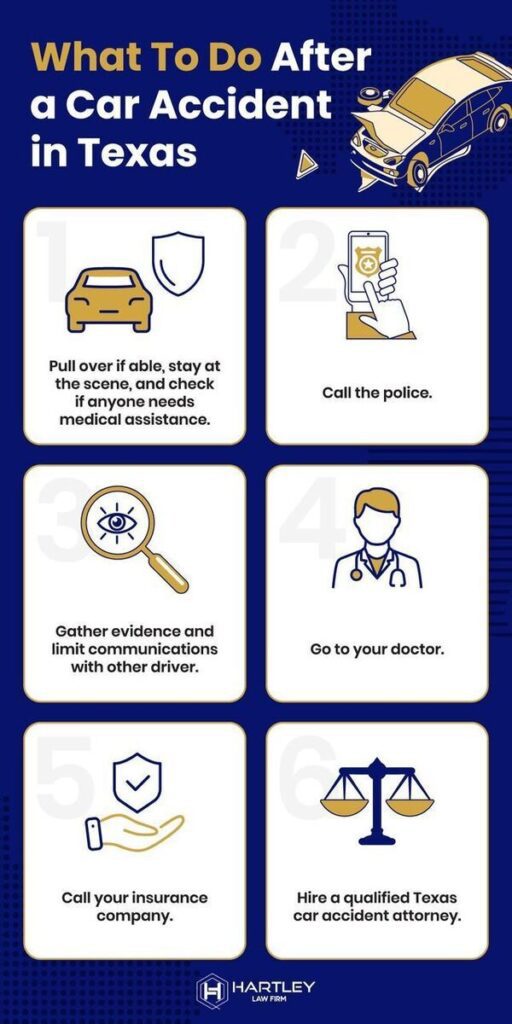
1. Pull Over if Able, Stay at the Scene, and Check If Anyone Needs Medical Assistance
Immediately after a crash, you will likely be in shock. Your adrenaline will be pumping, and it can be difficult to think clearly. Before anything else, focus on safety.
Under Texas Transportation Code § 550.021, drivers involved in an accident resulting in injury or death must:
- Stop immediately
- Remain at the scene
- Provide identifying and insurance information
- Render reasonable assistance to anyone injured, including arranging transportation to medical care if necessary
Leaving the scene of an accident involving injuries can be treated as a hit-and-run offense in Texas and may carry serious penalties.
If your vehicle can be moved safely, follow Texas’s “Steer It, Clear It” guidance and move it out of active traffic lanes. If not, turn on your hazard lights and get to a safe location.
After stopping, take a moment. Gather your thoughts. Check yourself and others for injuries. Adrenaline can mask pain, and what feels minor at first may not be. If anyone appears injured, disoriented, or asks for help, call 911 immediately.
The tone you set in these first few minutes – calm, controlled, and attentive – often carries through the rest of the encounter.
2) Call the Police
Even if the crash seems minor, contacting law enforcement is often one of the most important steps you can take. Texas law requires you to notify local police or the sheriff if:
- Anyone is injured
- A fatality occurred
- A vehicle is disabled
- Property damage appears significant
Beyond the legal requirement, there is also a practical reason: the driver who calls the police first is often perceived as taking responsibility for documenting the incident. Making that call allows you to provide your version of events before narratives begin to shift.
When an officer responds, they will prepare a CR-3 Peace Officer’s Crash Report, which becomes a foundational document for insurance claims, injury lawsuits, and liability disputes.
The CR-3 includes statements, diagrams, and the officer’s observations about contributing factors. It is far more persuasive than competing stories between drivers. It is important to know that Texas no longer uses the old driver-completed “blue form” (CR-2). Only a responding officer can file the official CR-3 report for qualifying crashes, and it is typically available within about 10 days.
If law enforcement does not respond, document everything yourself and notify your insurer promptly. Without an official crash report, disputes become harder to resolve.
3) Gather Evidence and Limit Communications With the Other Driver
If emergency medical care is not required, use the time before police arrive to document the scene. This is often where a claim is quietly won or lost.
Accident scenes change quickly. Vehicles are moved. Debris is cleared. Witnesses leave. Your memory begins to fade. What you record in the first 30 to 60 minutes may later become the most reliable version of events. Start by documenting the scene thoroughly. Capture:
- Both vehicles from multiple angles
- Close-ups of visible damage
- License plates
- Skid marks, debris, or road defects
- Traffic signals and intersection layout
- Weather and lighting conditions
Video can be especially helpful. A short recording explaining how the accident happened, made while the details are still fresh, can be valuable months later.
Also, take a moment to identify potential witnesses. If someone saw the crash, politely ask whether they would be willing to provide their contact information or speak with the officer. Nearby traffic or business cameras may have captured the collision as well – note their locations.
At the same time, keep conversations with the other driver limited and professional. Exchange names, contact details, and any other required information, check that everyone is okay, and avoid discussing fault. Do not apologize, argue, or speculate about injuries. Even statements like “I didn’t see you” or “I’m fine” can later be interpreted as admissions.
If the other driver presses you to discuss what happened, it is perfectly reasonable to say you would prefer to speak once the police arrive.
4) Go To Your Doctor
If you or someone else is seriously injured, seek immediate medical attention. Texas law requires you to render reasonable assistance if another person requests or needs care.
Even if injuries appear minor, schedule a medical evaluation as soon as possible. Many crash-related injuries, including concussions, soft tissue injuries, and herniated discs, do not present symptoms right away. What feels like general soreness can develop into a long-term issue.
Follow your doctor’s recommendations carefully. If you are prescribed 12 sessions of physical therapy, attend all 12 sessions. Do not stop after four visits simply because you begin to feel better. Insurance companies often argue that incomplete treatment suggests injuries were minor.
Keep organized records of:
- Medical visits
- Diagnostic testing
- Prescriptions
- Therapy appointments
- Notes about pain levels and physical limitations
Clear, consistent documentation helps your attorney understand the full extent of your injuries and helps protect your claim.
5) Call Your Insurance Company
Most auto insurance policies in Texas require prompt notice of an accident. Reporting the crash early preserves coverage and begins the claims process.
When contacting your insurer, provide factual and concise information. Avoid speculation about fault. Do not provide recorded statements to the other driver’s insurer without preparation, and do not sign broad medical authorizations without understanding their scope.
It is also important to understand your available coverage. Texas minimum liability limits are:
- $30,000 per injured person
- $60,000 per accident
- $25,000 for property damage
In serious crashes, these limits are often insufficient. Your own policy may include:
- Personal Injury Protection (PIP), which pays medical expenses and lost wages regardless of fault
- Uninsured/Underinsured Motorist (UM/UIM) coverage, which helps if the at-fault driver lacks adequate insurance
These benefits can provide immediate financial support while liability is sorted out.
6) Hire A Qualified Texas Car Accident Attorney
Insurance adjusters do not work for you. Their job is to evaluate and resolve claims on behalf of the insurance company.
Not every accident requires legal representation. However, it is wise to consult a Texas car accident attorney if:
- You suffered significant or ongoing injuries
- Fault is disputed or partially assigned to you
- The insurance company delays, denies, or undervalues your claim
- You are pressured to accept a quick settlement
- The crash involved a commercial vehicle, government entity, or uninsured driver
An experienced attorney can step in to preserve evidence, ensure fault is fairly evaluated under Texas’s proportionate responsibility rule, calculate the full scope of damages, and handle negotiations with insurers. If necessary, your lawyer can file suit and protect your rights in court.
Choosing legal representation is an important decision. The right guidance can significantly influence the outcome of your case. Hartley Law operates conveniently located offices in Carrollton and Irving, Texas, where you can speak with an experienced car accident attorney to discuss your options.
Additional Texas Laws That Affect Your Claim
Beyond the immediate steps you take after a crash, certain Texas laws can significantly influence whether you recover compensation and how much you may ultimately receive. Two of the most important legal principles involve fault allocation and deadlines. Understanding how these rules work can help you avoid surprises during the claims process and better protect your rights.
Texas Proportionate Responsibility Rule
Texas follows a modified comparative fault system. You may recover damages only if you are 50% or less at fault. If you are found to be more than 50% responsible, you cannot recover compensation.
If you share fault, your recovery is reduced by your percentage of responsibility. For example, if you are 20% at fault and your damages total $100,000, you may recover $80,000. Insurance companies frequently attempt to increase your assigned percentage of fault to reduce payouts.
Statute of Limitations
In most cases, Texas law gives you two years from the date of the crash to file a personal injury lawsuit. Missing this deadline can result in your case being dismissed permanently. Accidents involving government vehicles may require formal written notice within 45 to 180 days. Waiting too long can eliminate your right to recover damages.
Vehicle Repairs and Property Damage
Before repairing your vehicle, allow the insurance adjuster to inspect and document the damage. Repairing it too quickly can eliminate important evidence and create disputes about the extent of the loss.
Obtain written repair estimates and keep copies of all receipts, including rental car expenses. Insurance companies generally owe for a reasonable period of loss of use, but returning the rental promptly helps avoid complications.
You have the right to choose your own repair shop. If you disagree with your insurer’s valuation, consider getting independent estimates to ensure the damage is properly assessed.
Common Mistakes to Avoid After a Texas Car Accident
Even small decisions in the hours and days after a crash can weaken your claim. Insurance companies look for inconsistencies, admissions, and procedural mistakes to reduce payouts. Avoid the following common errors:
- Leaving the scene: Leaving the scene of an accident involving injuries can result in criminal charges under Texas law. Even in minor crashes, failing to remain at the scene can damage your credibility and harm your insurance claim. Always stop, exchange required information, and comply with reporting obligations.
- Apologizing or admitting fault: It is natural to want to apologize after an accident, but statements such as “I’m sorry” or “I didn’t see you” can later be interpreted as admissions of liability. Texas follows a modified comparative fault rule, and even a small increase in your assigned fault percentage can significantly reduce compensation.
- Posting about the accident on social media: Insurance companies routinely review public social media accounts. Photos, status updates, or comments about your activities can be taken out of context and used to argue that your injuries are not serious. It is best to avoid posting anything related to the accident or your recovery while your claim is pending.
- Accepting early settlement offers: Insurance companies sometimes make quick settlement offers before the full extent of injuries is known. These early offers often do not account for future medical care, lost income, or long-term effects. Once you accept a settlement and sign a release, you typically cannot reopen the claim.
- Signing blanket medical releases: Some insurers request broad authorizations that allow them to access your entire medical history. This can give them the opportunity to search for pre-existing conditions and attempt to shift blame. You should understand exactly what you are signing before granting access to your records.
- Repairing your vehicle before inspection: Do not repair your vehicle before the insurance adjuster has documented the damage. Premature repairs can eliminate evidence that may be important in determining fault or the severity of impact. Always obtain written repair estimates and keep copies of all documentation.
- Assuming minimum insurance coverage is sufficient: Texas minimum liability limits ($30,000 per person / $60,000 per accident / $25,000 property damage) are often inadequate in serious crashes. Medical expenses can quickly exceed these limits. It is important to evaluate whether uninsured/underinsured motorist coverage or other policies may apply.
- Waiting too long to seek legal advice: Evidence can disappear quickly, surveillance footage may be erased, and witness memories fade. Additionally, Texas has a two-year statute of limitations for most personal injury claims, and some cases (such as government vehicle accidents) have much shorter notice requirements. Delaying legal guidance can permanently affect your rights.
Even seemingly minor missteps can significantly affect your ability to recover full compensation.
Hartley Law Can Help Protect Your Rights
Car accident claims in Texas involve strict deadlines, insurance tactics, and fault rules that can significantly affect your recovery.
Hartley Law operates conveniently located offices in Carrollton and Irving, Texas, where you can speak with an experienced car accident attorney about your case and next steps. If you have been injured in a Texas car accident, scheduling a consultation can help you protect your rights, recover the compensation you deserve, and move forward with confidence.
Frequently Asked Questions About What To Do After a Car Accident in Texas
What happens if both drivers are at fault in a Texas car accident?
Texas follows a modified comparative fault rule, sometimes called proportionate responsibility. You may recover damages as long as you are 50% or less at fault. However, your compensation will be reduced by your percentage of responsibility. If you are found to be more than 50% responsible, you cannot recover damages. Shared-fault cases often involve detailed evidence analysis, including crash reports, witness statements, and vehicle damage patterns.
Can I still file a claim if I wasn’t wearing a seatbelt?
Yes. Not wearing a seatbelt does not automatically prevent you from filing a claim. However, the insurance company may argue that your injuries were worsened because you were unrestrained. This argument can potentially reduce compensation under Texas comparative fault rules. Each case depends on medical evidence and the circumstances of the crash.
How do I negotiate with insurance companies after a car accident?
When communicating with insurers, provide clear and factual information, but avoid speculation or recorded statements without preparation. Do not accept settlement offers before understanding the full extent of your injuries and damages. Keep documentation of medical treatment, repair estimates, and lost wages. If liability is disputed or settlement offers appear inadequate, consulting an attorney can help protect your position.
What mistakes should I avoid after a car accident?
Common mistakes include admitting fault, posting about the crash on social media, accepting early settlement offers, signing broad medical releases, and delaying medical treatment. These actions can reduce the value of your claim or give insurers grounds to dispute it.
How do Texas laws affect my car accident claim?
Texas law affects your claim in several important ways:
- The two-year statute of limitations limits how long you have to file a lawsuit.
- The modified comparative fault rule reduces or eliminates compensation depending on your share of responsibility.
- Minimum insurance limits may restrict available recovery if the at-fault driver lacks sufficient coverage.
Understanding how these laws apply can significantly affect your outcome.
Are there specific reports or forms I need after a crash in Texas?
If law enforcement responds, they will file a CR-3 Peace Officer’s Crash Report. Texas no longer uses the driver-filed “blue form” CR-2. The CR-3 report becomes important documentation for insurance and legal claims. If no officer responds, you should still document the scene thoroughly and notify your insurer promptly.
Why is documenting the accident scene so important?
Photos, videos, witness information, and notes taken immediately after the crash can preserve critical evidence. Road conditions change, vehicles are repaired, and memories fade. Early documentation can make a significant difference in liability disputes.
When should I call a lawyer after a car accident?
You should consider speaking with a lawyer if:
- Your injuries are serious or worsening
- Fault is unclear or disputed
- The insurance company pressures you for a quick settlement
- The accident involved a commercial or government vehicle
- You are unsure how Texas deadlines or insurance laws apply
Consultations are often free and can help you understand your options before making important decisions.
Areas We Serve
We provide expert legal support to auto accident victims in the following cities – contact our car accident attorneys today: